You have probably seen him already
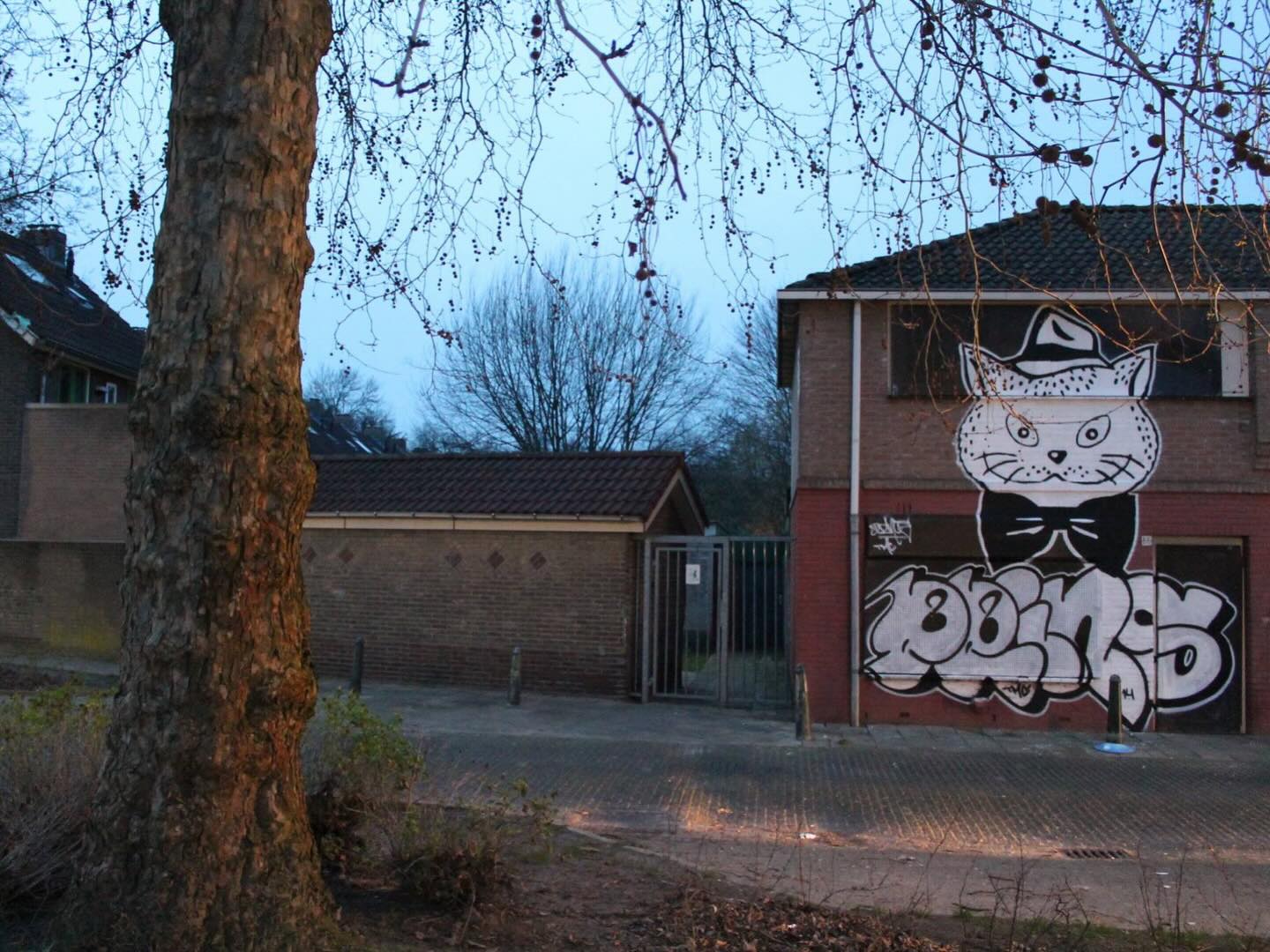
Once you start paying attention to Gato, you begin to recognise him everywhere: on a post you pass every day, on the back of a traffic sign or on a wall where he has become part of a larger image. The cat appears in many roles and surroundings, yet always remains unmistakably himself.
To the maker, Gato is not a logo with a fixed message. He describes him as a playful countervoice in a world where almost everything is trying to sell something, from advertising to politics. The aim is much simpler: to make someone smile and perhaps briefly question what normally feels self-evident.
“People regularly tell me that once they begin noticing graffiti and stickers, they start looking at the world around them with completely different eyes.”
That is precisely what Gato does. He adds no advertising message to the city, but a small moment of wonder. Once people have discovered the cat, they begin to look differently at the backs of traffic signs, utility boxes and forgotten corners.
Even the maker does not know exactly how often Gato has appeared in the streets. As a sticker alone, however, he has now passed the mark of 100,000 copies. Gato also appears on posters, tiles and other attached materials. That presence is not the result of a single campaign or a deliberate pursuit of attention, but of years of experimenting, travelling and repeatedly finding places where Gato can come to life.
“The 100,000-sticker mark has been reached.”
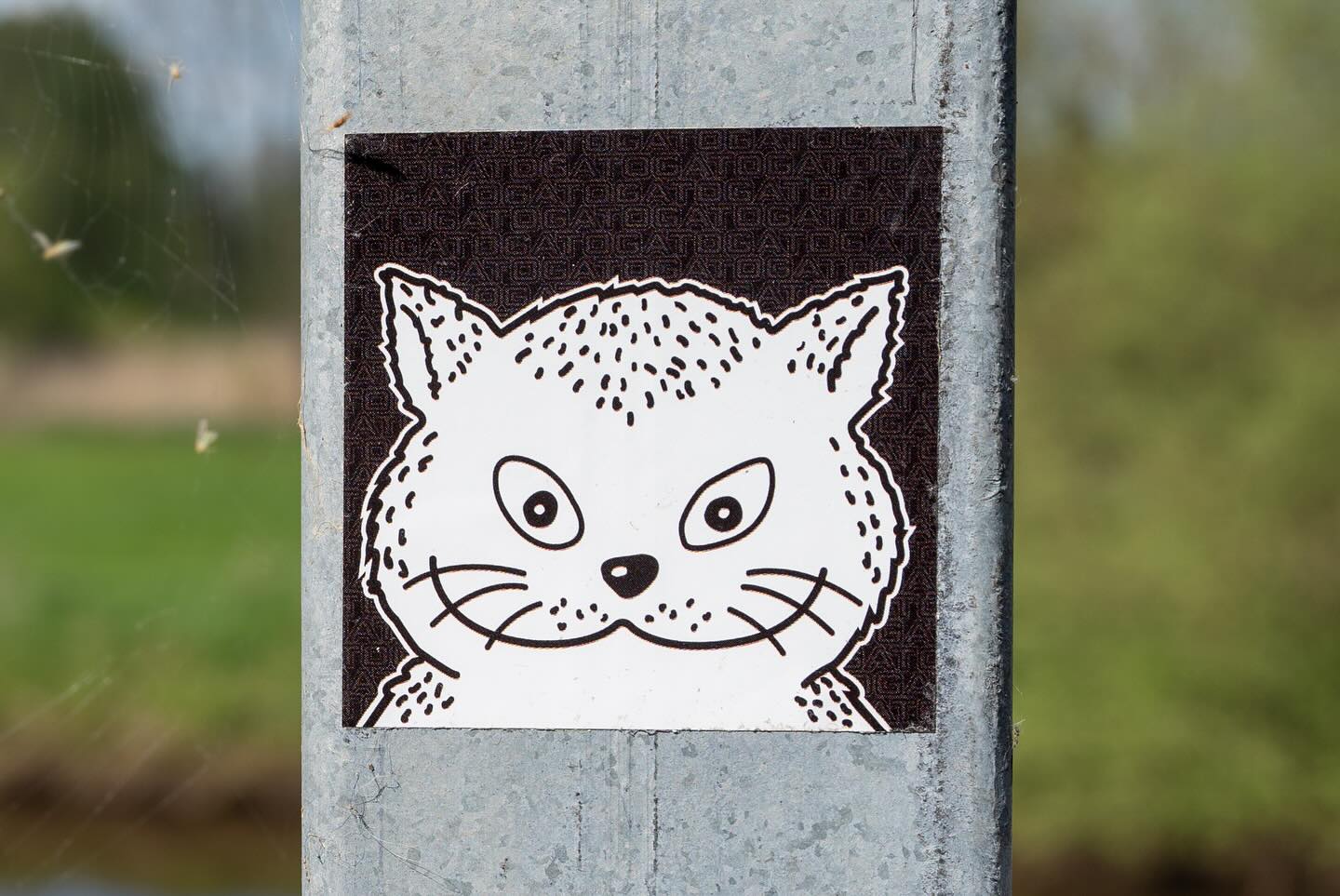
Streetcat since 2006
Gato’s history does not begin immediately with the cat Eindhoven knows today. In 2006, the maker decided he could afford to skip a few hours of school. He bought spray cans with a friend and went to the Berenkuil, Eindhoven’s well-known legal graffiti site. That is where his interest in graffiti and stickers began. The final form of Gato emerged roughly three years later.
For him, the reference to 2006 is mainly about the beginning of his experiments in the street. From that year onward, he built the knowledge and experience from which Gato eventually grew. Gato as we know him today did not yet exist, but without that foundation the maker would never have reached the same point. In the past, he even used designs carrying the words “Gato since 2006”.
The name did not come from a great love of cats. Friends used to call him “cat” because he could climb well, was agile and was often out in the streets at night. Whenever something happened, he had usually disappeared before anyone noticed. The joke that he must have nine lives was an obvious one.
Cat, kat and other variants did not feel like the right name. Then a Chilean friend told him that the Spanish word for cat is “gato”. He did not immediately love the sound of it, but decided to embrace the nickname. He has stayed loyal to it ever since.
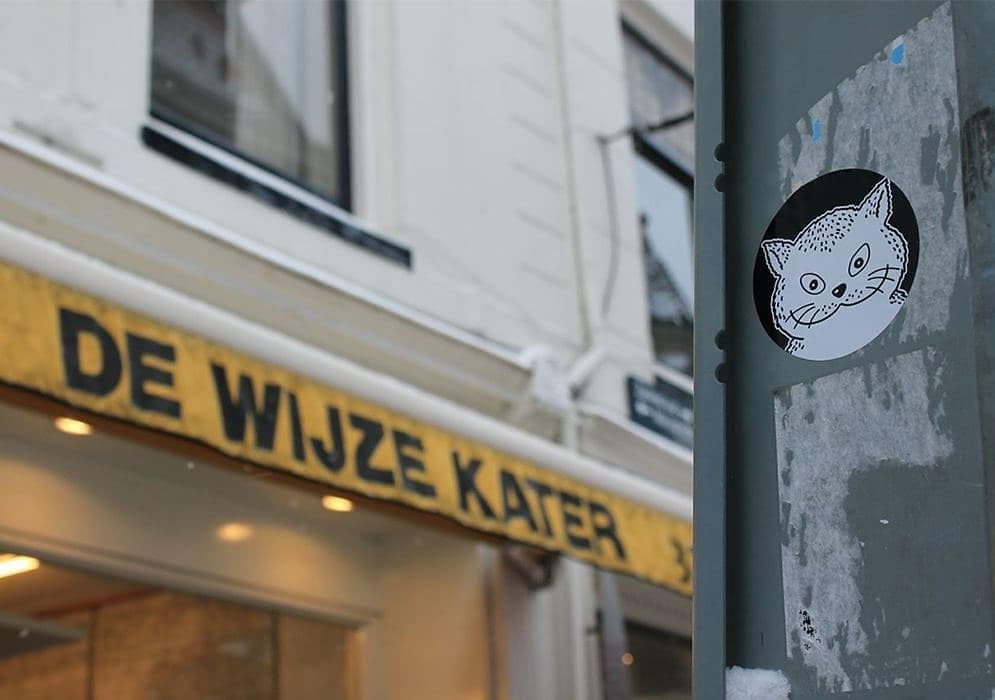
Ninety percent Gato
Gato is a character, but not a mask hiding a completely different personality. Asked how much of himself is present in the cat, the maker gives a surprisingly precise answer: around ninety percent. The remaining ten percent consists of things Gato experiences or does that the maker himself would probably never do.
Many scenes contain small references to his own life. A passer-by does not need to recognise them. What matters more is that someone may recognise themselves in a situation, or feel touched by an image without knowing exactly why.
At the same time, he deliberately protects the separation between Gato and his everyday life. Family, colleagues and even some friends do not know this side of him exists. That anonymity offers freedom, but it also brings responsibility. Although he could theoretically say anything through Gato, he tries to keep the character away from news and current affairs as much as possible.
“Gato is for everyone,” he says. When a fan tells him that the cat has been a bright spot, it confirms that choice. At the same time, he considers it important that the imagery remains suitable for the younger fans who follow Gato as well.
Eindhoven as a playground
A street artist moves through a city differently. Where most people see a post, wall or box, Gato sees a possible surface, a memory of work that once hung there, or a place still waiting for the right idea.
Eindhoven has become familiar territory. At many locations, he still knows exactly who left something there and what could be seen in the past. Sometimes he has returned to the same place several times himself. That is precisely why he enjoys new projects and unfamiliar areas: a city or country where he has never been active before.
His aim is not simply to leave as many stickers as possible. He wants to become present enough for local artists to start noticing him, until it briefly feels as though Gato has always been part of their scene.
The interaction between design and place differs every time. Sometimes a Gato comes first and he spends weeks looking for the location where it will work best. Sometimes he sees a place and immediately knows which image belongs there. To him, a sticker is a small artwork, a miniature world that can appear with little effort and disappear just as quickly.
A painted or larger Gato requires a different relationship with the location. For his own idea, he looks for a spot that strengthens the story. With a legal commission, it often works the other way around: someone offers a place and asks whether he wants to do something with it. But an available location is not automatically a good location. Nine times out of ten, he does not feel enough connection with the spot.
Because he does not need to earn his income through Gato, he has the freedom to say no. “Gato is part of my life, not a job.” He saves his creative energy for ideas and locations that genuinely excite him.
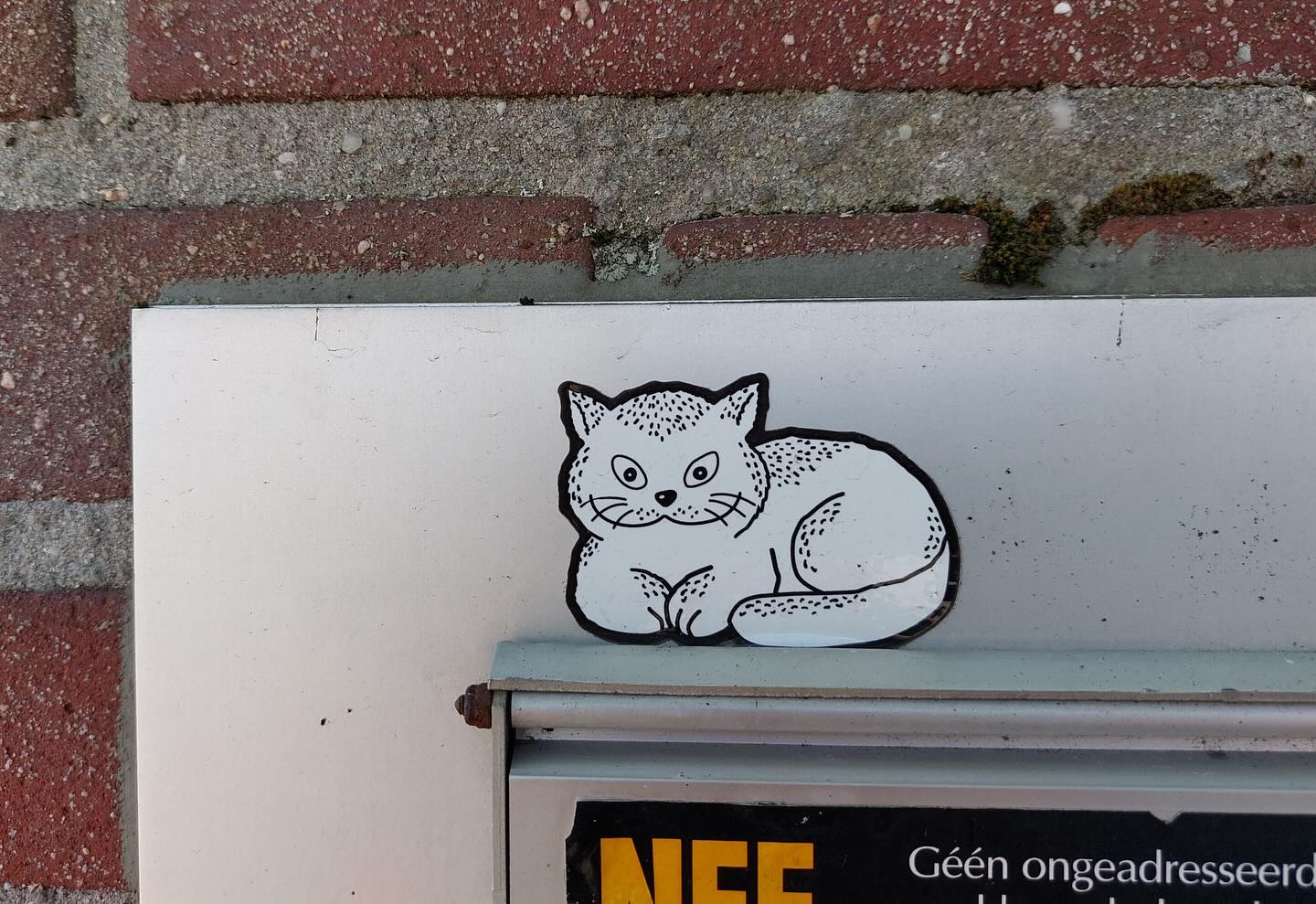
You cannot force a Gato
A design does not need to be finished immediately. Sometimes an idea does not work, and the answer is not to push harder. The maker lets it rest. Months or even years later, location, story and image may still come together. If they do not, a design is also allowed to disappear.
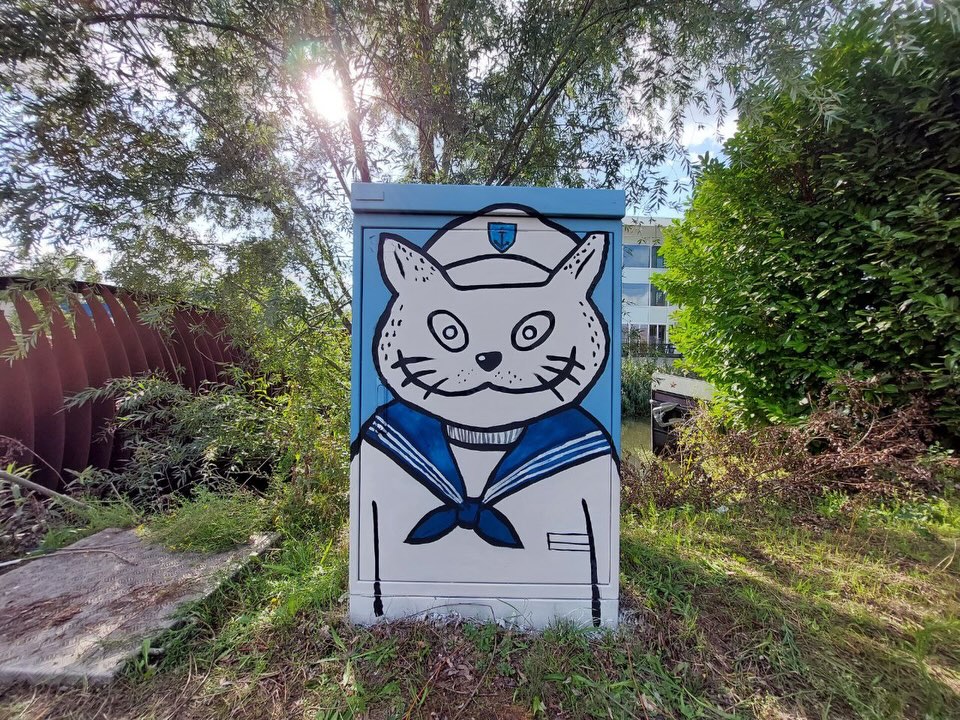
That is why Gato’s different roles are rarely random costumes. Almost every design has a reason behind it, and the surroundings can be decisive. The sailor, for example, stands near the only street in Eindhoven that still has houseboats. The costume is a nod to the boats, the harbour area and the sailors who might once have been there.
The character remains recognisable but adapts to the place. That is why Gato does not feel like the same stamp repeated everywhere, but like a figure genuinely moving through the city.
Between permission and freedom
Street art almost automatically exists in a field of tension. Some works are made with permission, while others emerge in a greyer area. For Gato, that contrast is not the main starting point. A place primarily needs to fit the idea.
He is critical of an art world in which legal work is sometimes automatically treated as more valuable, especially when an approved work is painted over something into which another maker invested time, money and risk without permission. The fact that something is officially allowed does not automatically make it better.
What attracts him to graffiti and other forms of art in public space is precisely their independence: someone sees a place and decides to do something with it. If only art approved in advance by a municipality is allowed to remain, he believes the city risks becoming monotonous.
That freedom also makes the work vulnerable. A sticker can be damaged, removed or covered by another. Its temporary nature is not a flaw in the system, but part of the street. Gato appears without any guarantee that he will remain.
Gato meets other worlds
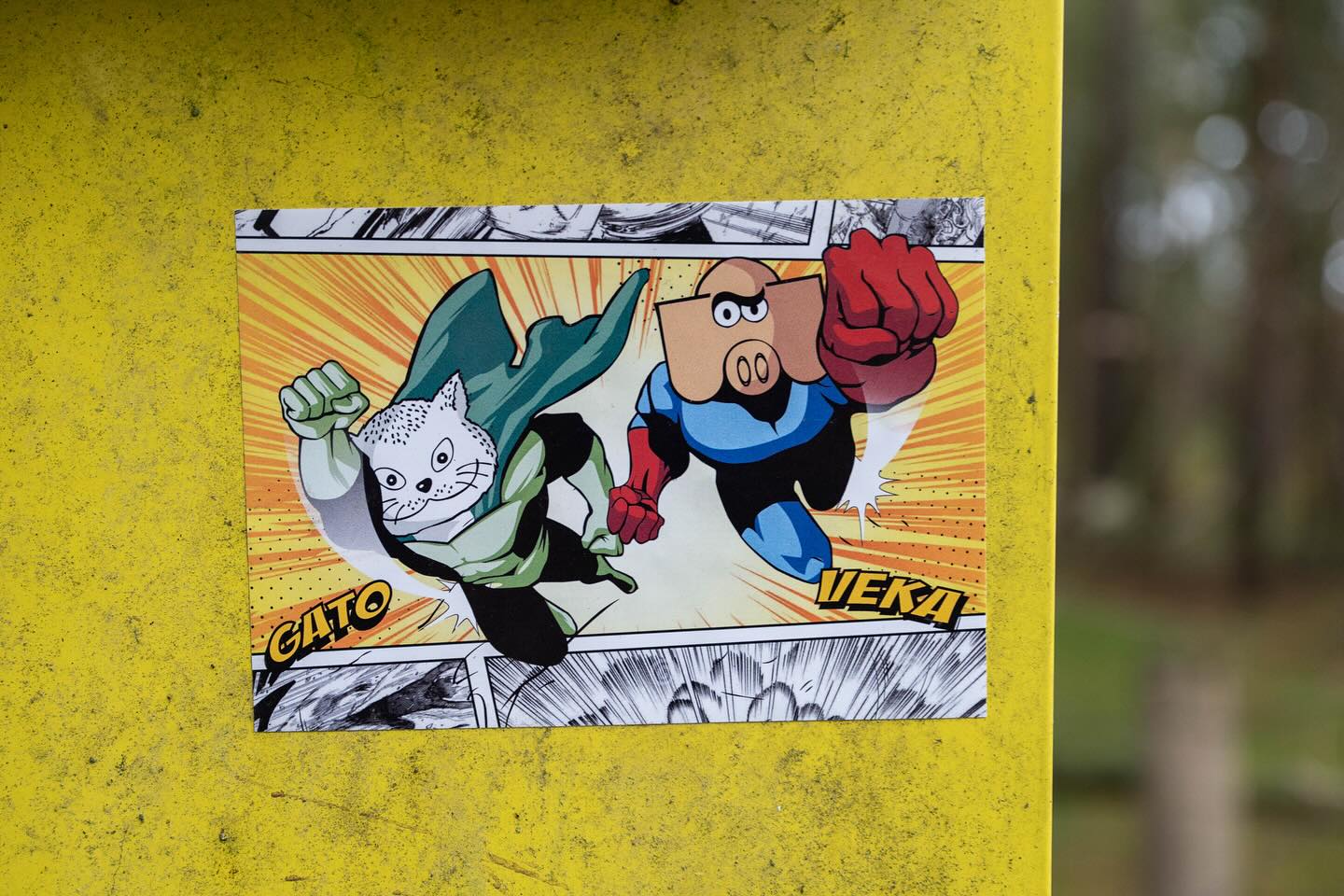
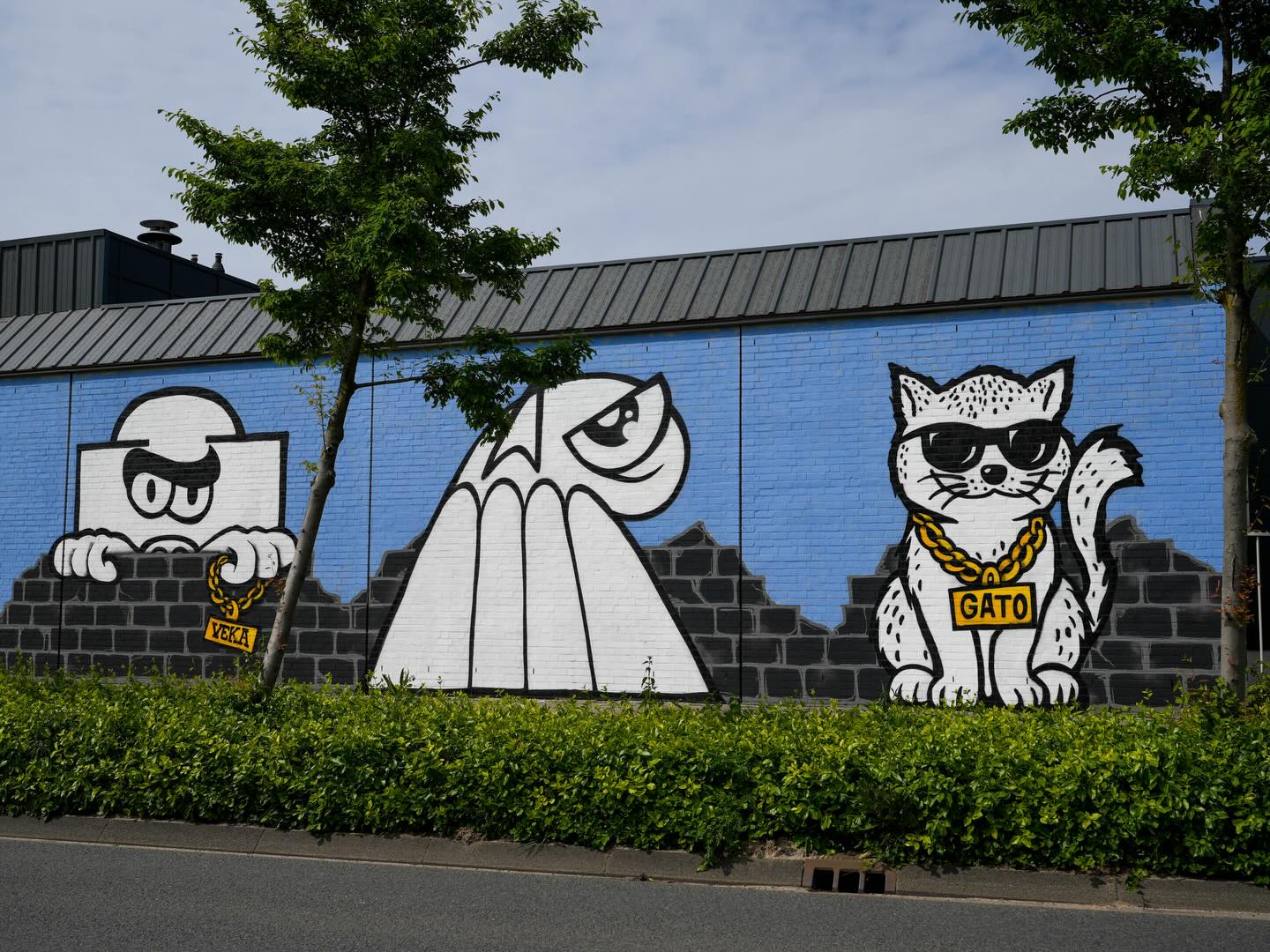
Although the cat has a strong character of his own, he does not live in isolation. Gato regularly collaborates with other artists. Those collaborations are not driven by reach, status or the desire to place as many names together as possible. He chooses people he knows or genuinely supports.
He relies on the same feeling that makes a location suitable. If he feels nothing for someone’s work, sees no idea or senses no creative connection, he does not begin. Often, he says, you already know in advance whether a collaboration can work.
That principle fits the idea behind Eindhoven Creator Community. A creative city is formed not only by individual makers, but by people who see one another, challenge one another and give one another space. In a successful collaboration, two styles do not disappear into each other. Instead, they make clearer what each person contributes.
Visible, but not available
Gato’s Instagram profile sets two clear boundaries: “No sticker trading” and “Social media isn’t really my thing”. That may seem contradictory for someone who shows his work online, but the distinction is logical to him.
He creates Gato first and foremost for himself. Stickers are meant for the street, in places where people encounter them unexpectedly — not to disappear into a collector’s shoebox. The world of sticker trading is allowed to exist, but it is not where he wants to spend his time and energy.
He deliberately uses no hashtags or promotional strategy. Building a broad online following is not the goal; a random follower on the other side of the world adds little to what Gato is trying to do in the street. Most people first saw the cat in the real world and then went looking for the maker themselves. He values that route: wonder first, curiosity second, and only then the profile.
Sometimes he stands at a creative spot while people next to him talk about “that little cat”, unaware that the maker is right there. That may be what he likes most: Gato is recognisable while the mystery remains intact.
For him, social media is mainly a place where an unexpected message occasionally arrives and where he keeps in touch with other people in the scene. Being visible does not mean everything has to be available.
How big should Gato become?
What if the municipality of Eindhoven offered an entire building tomorrow for one enormous Gato? Even then, there would be no automatic answer. One place might fit perfectly, while another place might evoke nothing despite its scale. Size is not the same as meaning.
There are still plenty of ideas waiting and artists with whom he would like to collaborate. Yet the most interesting question about the future may not be how big Gato can become, but what a small work leaves behind.
In twenty years, a half-decayed sticker might still be sitting on a utility box somewhere. The maker hopes people will not only think: nice cat. He hopes that despite all the stimuli around them, they will still feel the creative energy to make something themselves.
Gato is not only the result of one person, but also of adventures, friends, failures and many hours of continuing to try. The best possible outcome is that an old Gato makes someone pause for a moment to consider the story behind the image — and perhaps gives them the motivation to pursue an idea of their own.
Want to discover more of Gato’s work? Look more closely at the city during your next walk or bike ride, or visit @monsieur_gato on Instagram.
Discover more work?
Walk or cycle through Eindhoven with fresh eyes, or visit @monsieur_gato on Instagram.